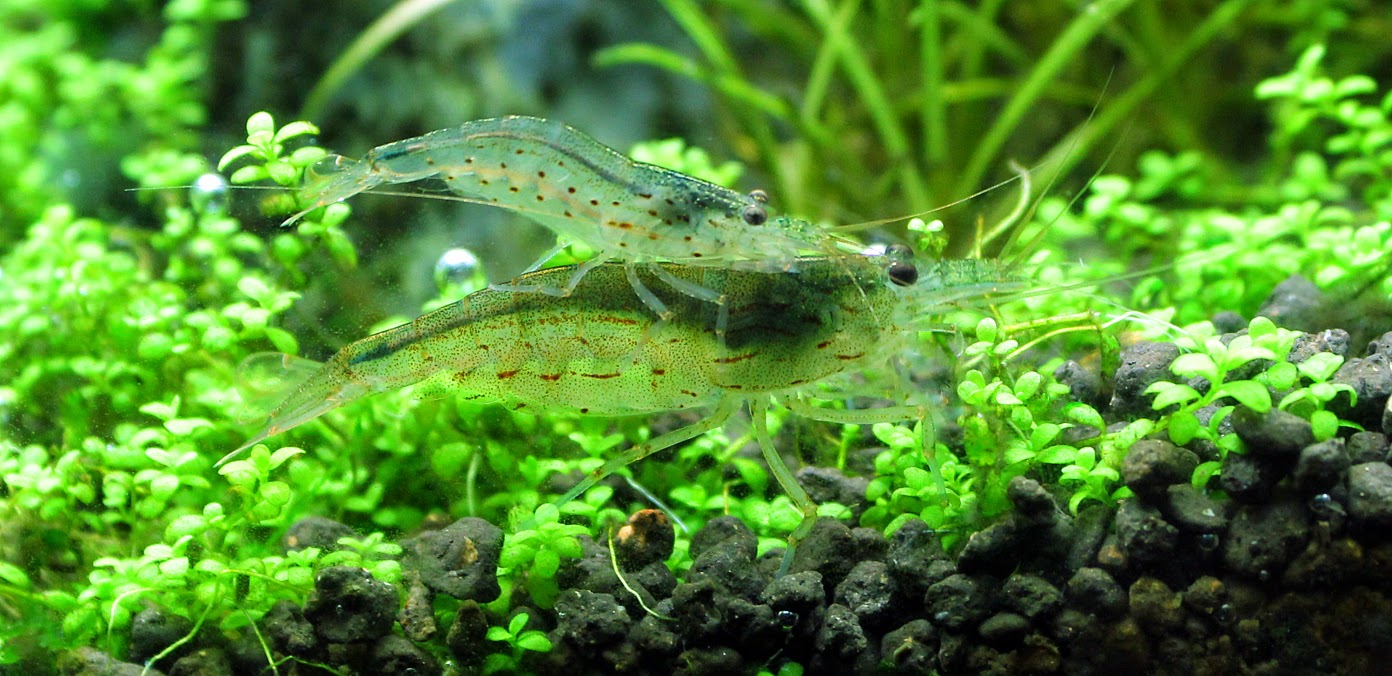
Scientific Name: Caridina Multidentata
English Name: Amano Shrimp
Origin:  Taiwan, Japan and Korea
Adult Size: Up to 2 inches (5 cm)
Behavior: Peaceful
Tank Level: Bottom
Minimum Tank Size:  10 gallons or larger
Diet: Omnivore
Breeding: Egg layers
Care level: Easy
Water pH: 6.0-7.0
Water Hardness: -
Water Temperature: -
Water Movement: -
Lighting: -
Lifespan: -


Scientific Name: Puntius titteya
English Name: Cherry barb, Crimson Carplet
Origin:  Sri Lanka
Adult Size: Up to 2 inches (5 cm)
Behavior: Peaceful
Tank Level: All over the tank
Minimum Tank Size:  10 gallons or larger
Diet: Omnivore
Breeding: Egg layers
Care level: Easy
Water pH: 6.0-7.0
Water Hardness: 5 to 19 dH
Water Temperature: 73.0 to 79.0° F
Water Movement: Moderate
Lighting: Moderate – normal lighting
Lifespan: 5 – 7 years

Do not overfeed your fish.

Fish are cold blooded and as such they only need food for energy and health. They do not needs huge amounts of food to heat their bodies like us. Your aquarium heater does that. Overfeeding is a common mistake and leads to unhealthy fish in dirty aquariums. I recommend feeding daily and have one day a week where you don't feed them at all. If your fish are hungry at feeding time and visibly excited, this is a good sign that you have healthy fish.

Try and give them a bit of variety in their diet. Buy them a few different food types and mix it up. Over the course of a week, I recommend 5 days of various dry foods, 1 day of frozen or live food. The dry foods are packed with nutrients, but live food and frozen live food are a great source of protein and they love it. It is not good to give too much live/ frozen food as it makes a mess and dirties the tank and doesn't contain good balanced nutritional content.

The instructions on fishfood packets usually says to give them as much as they will eat in a few minutes several times a day. I believe this is wrong! Fish will eat an enormous amount in a few minutes and feeding this much will lead to dirty aquariums and unhealthy bloated fish. The manufacturors of food clearly have a vested interest in you using more food. Once a day as much as they eat in one minute will usually be fine.

Some fish like small amounts blanched lettuce or spinach or pieces of cucumber. Do not leave these in the tank though. Remove the remains after 1 hour.

You may well need to use different types of food for different fish. For example your bottom dwelling catfish will not feed on flake. It can be hard to get the right food to the right fish. I recommend using the following tactic. Feed bottom dwellers first and let their pellets or wafers sink to the bottom. Delivery through a piece of filter tube to the bottom can be useful to stop your fiesty middle dwellers stealing it before it reaches the bottom. Next very quickly feed the middle top dwellers, to distract them from stealing the bottom dwellers food.

Depending on your fish, you may need to device other tactics to get the right food to the right fish. It can be funny to watch, but if middle dwelling fish get hold of catfish wafers a game of fishtank rugby often ensues.

Blocks of frozen live food are best delivered by half filling a glass with tank water, dropping in the food blocks and leaving for 10 minutes to thaw. Give it a stir to break up all the bloodworm, brineshrimp or whatever and then poor into the tank. The act of filling a glass in the tank sends my fish into a frenzy of excitement.
Take a little bit of regular time to enjoy your fish tank, watch the fish and their behaviour. You can tell if your fish are happy and healthy if they respond to your presence by wanting food. Be aware that fish behaviour may well change when you are present. This can be a good indicator though, if fish hide away when you are around the tank, there may well be a problem. Fish that do not come out for food may well be ill or stressed.

Some species may become a little fiesty with each other if you are present and you do not feed them. I have especially noticed this in Barb species, if you are around for a while the dominant fish may weel want to demonstrate that they are the boss. This is quite ordinary and rarely results in any serious injury. If your fish are seriously hurting each other, then you have a problem and you may want to remove one to balance out the community.

The colouration of your fish is another good indicator of tank and fish health. If your fish are looking pale you may well have a problem.

Check that the filter flow is OK, check the temperature is stable and correct, check that there isn't too much algae. Smell the water to check that there is no decay. If the water smells noticably bad, you probably have a problem.

If you see any large piles of muck, do a water change/ clean asap.

Good water quality is an essential aspect of fishkeeping. Broadly speaking, if you have a good community and you look after the water quality, the fish will look after themselves. See other topics below for further tips about maintaining good water quality.


Essentials are:
  1. Regular cleaning
  2. Good filtration
  3. Not over-feeding
  4. Minimum dead space
  5. Not having too many fish
  6. No dead/decaying plants


1. Neon Tetra


2. Cardinal Tetra


3. Serpae Tetra


4. Diamond Tetra


5. Glowlight Tetra